
What’s wrong with the Internet?

I just have a lot of feelings, from Mean Girls

BuzzFeed is not known to be a shining beacon of quality journalism. It has a reputation for link-bait headlines (“38 Crazy Things You Never Knew About Kangaroos”) leading to GIF-laden lists. It publishes quizzes (answer a bunch of seemingly random questions before a script shows you the logical conclusion of your answers) so unscientific that no one should ever take them seriously for big life decisions.

BuzzFeed thrives on the short attention span of Generation Z—children born into an age when they can expect news to be spoonfed to them in bullet points and images.
I just have a lot of feelings, from Mean Girls
… how could long walls of text about important things ever compete with simple GIFs worth a thousand words?

The people behind The Onion certainly saw right through this. They recently launched “ClickHole — Because all content deserves to go viral”, to parody both BuzzFeed and every other content-aggregating website that feeds on social media frenzies. (Worth mentioning: ClickHole parodies far more than BuzzFeed itself; it even incorporates references to Upworthy, the feel-good viral-video site with a cloying habit of telling you what to think about its clips before you’ve even watched them.”)

ClickHole, the Onion's parody of viral content
ClickHole, the Onion’s parody of viral content

But BuzzFeed has also published some high-quality longform pieces, dubbed BuzzReads. These are serious articles that cover the entire spectrum of subject matter, from politics, to technology, to rape and social justice. They’re of sufficient quality that they could easily pass for an extended newspaper exposé or magazine centrepiece. Targeting a more mature audience seeking longer reads, these feature stories often carry the same socially-liberal perspectives espoused by the rest of the site, while employing words more eloquent than their pop-culture GIFs could ever be.

I’ve had my doubts that BuzzFeed can sell itself in both markets. As great as the quality of their content may be, and as awesome as their access to reliable sources might be (the site has a DC operation with press pass access), it’s hard to “[break] down the divide between the light and the serious.” It’s a challenge the site’s editors realize:

“I think we need to show people that it’s up to us to write it in a way that has the context, has a compelling narrative to it. If you give them more of this and mix it in with fluff, and it’s treated equally by the publication, the public will start to treat it the same way too.”

Two years later, I think they’re starting to make some headway, at least among the social media users who are more publishers than consumers. People are sharing BuzzFeed’s longform essays on social media, using the site’s content to express beautifully the thoughts they could not write themselves.

What’s the reception like? I think many people on the consuming end of content are still sometimes skeptical. And I’m not sure that many people associate BuzzFeed sufficiently with quality content that they would be willing even to give reading BuzzReads a chance.

Case in point? This ignorant comment posted by a BuzzFeed reader on a post about the termination of American Apparel CEO, Dov Charney.

People don't like serious BuzzFeed
Apparently some people don’t like BuzzFeed getting serious.

That article wasn’t even a longform essay. BuzzFeed had, through an anonymous leak, obtained an exclusive copy of the CEO’s termination letter, which no other news outlet reportedly had done. It was news, and it was worldly.

Apparently too worldly for this one commenter, who seems to think that only funny, entertaining, and “pertinent” (whatever that means in this context) content deserves to be published on a site from which they expect only entertainment.

I would be a fool to equate this one person’s opinion with everyone else’s. However, this is merely one example of the derisive attitude towards long online content I’ve witnessed first-hand—scroll through my Facebook timeline, or my friends’, and you will certainly find that GIFs and short interactive quizzes get more likes and click-throughs than essays about anything.

Why is that? It’s not like everyone is working 18-hour days in finance… Why don’t we, college students and young professionals, seem to have time for intellectual engagement outside of the classroom, on the Internet?
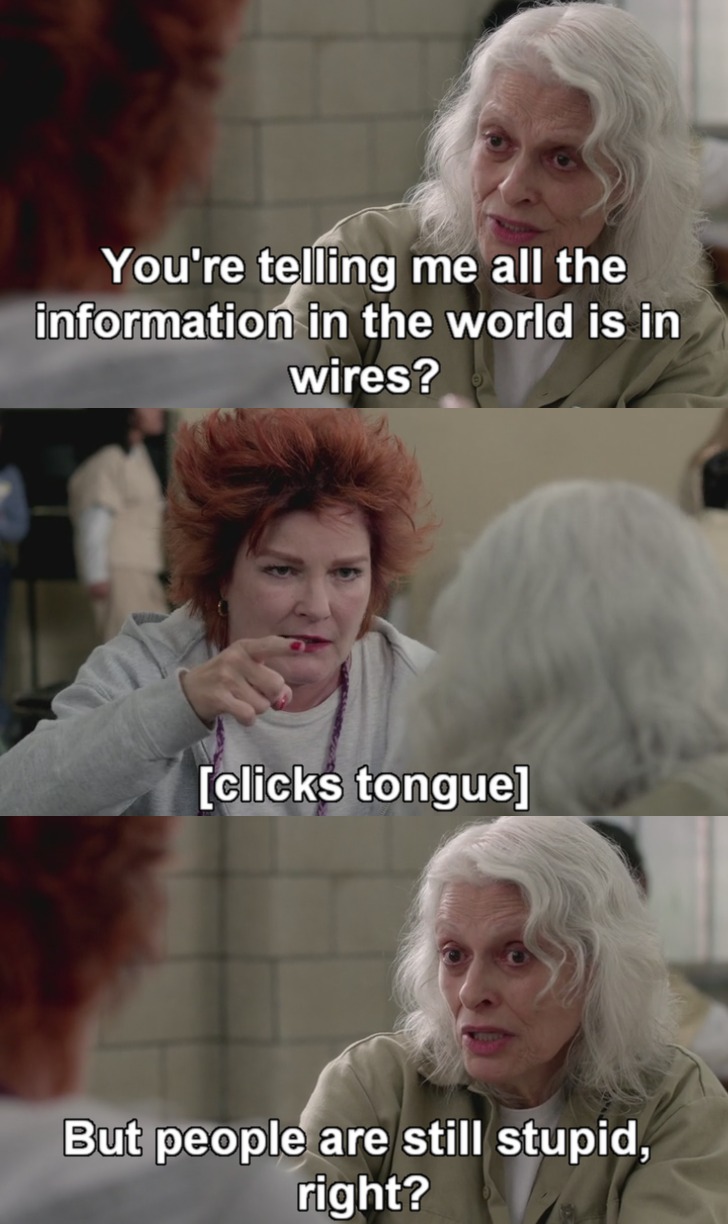
Old lady learns about the Internet from Orange is the New Black
An old prisoner learns about the Internet. From Orange is the New Black, season 2.

This old lady learns about the Internet for the first time, in Orange is the New Black—my newest favourite show. “But people are still stupid, right?” Indeed, the very technologies that made information so much easier to access, also made it easier to seek information in the shortest tidbits possible. Why read an entire screen of text, if you can get the essentials in 10 animated images?

There’s something deeply disturbing about this trend. It’s different—markedly different—from high school classes recognizing comic books as valid literature. This is a trend that makes education and self-expression more difficult, and less valuable in the eyes of this generation.

Media in our technological age must seek not only to earn pageviews, but also spark deep, insightful conversations about important contemporary issues. Instead of stooping to the lowest common denominator, as BuzzFeed seems to have done in its early launch, they have to champion the cause of literacy and engagement.

Why are genuine discussions about ethnic conflict or self-determination (indeed, a late-night discussion I’ve had quite a few times this week with my friends) outside of the academic environment so rare? Maybe, in part, it’s because of the Internet we consume.
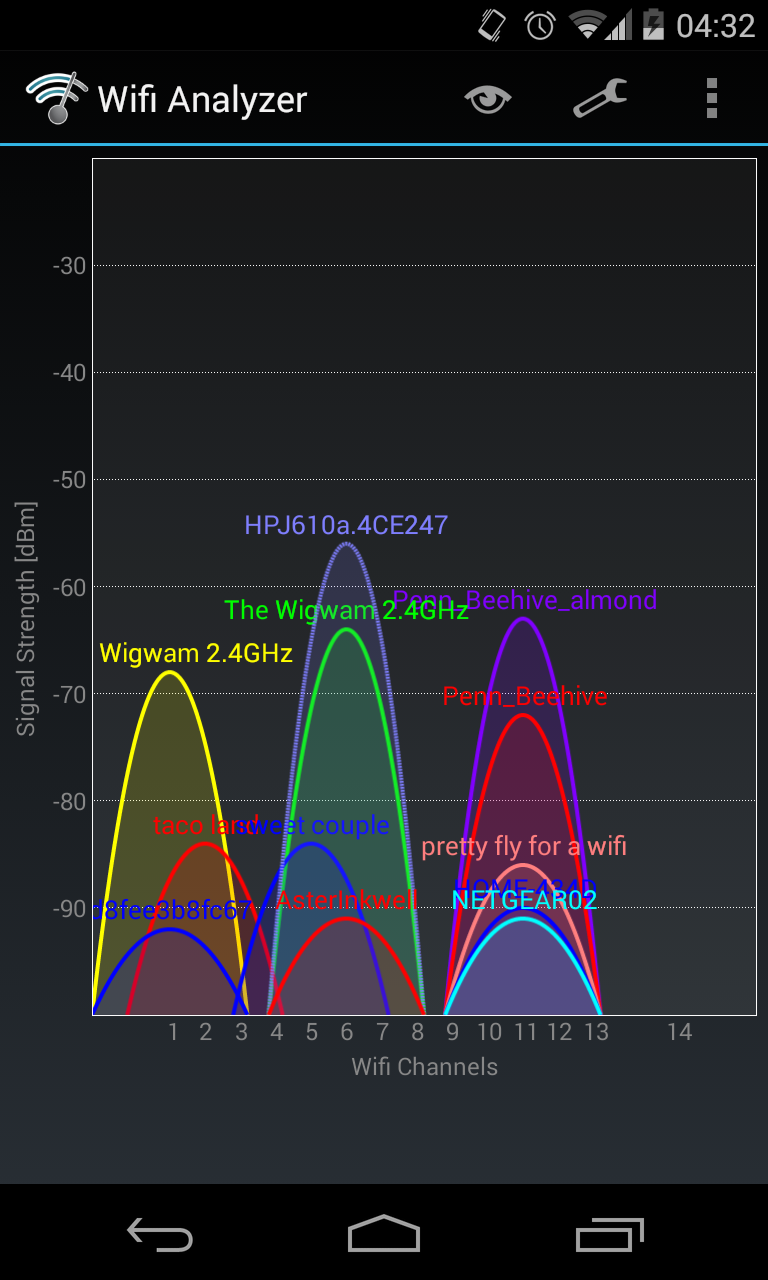
Dear HP

image

To whichever engineers at Hewlett-Packard decided that it would make sense to pollute our frequencies with unneeded ad-hoc printer wifi networks enabled by default… You messed up.

Now every university dorm has to cope with unimportant personal printers putting out stronger signals than the nearest real access point. And houses in residential neighbourhoods receive neighbours’ printer signals more strongly than the high-power N/AC router.

I get that owners can connect them to routers instead of being separate APs. But guess who’s not turning off this “feature”? All of your least tech savvy customers.

(Side note: Comcast’s wider deployment of cable modem-router devices in homes and businesses with secondary xfinitywifi hotspots produces the same issue when customers are plugging in their own wireless routers right next to the Comcast device. I love using xfinitywifi, but there are real issues unless Comcast has configured these hotspots to scan for surrounding networks before deciding whether to broadcast a signal. And again, while there may be an opt out option, it’s the least tech savvy users who don’t turn it off, who generate potential interference for their neighbours. Negative externalities!)

It bothers me that the current default is a situation where tech-dumb people piss off tech-smart ones.

Town of Greece v. Galloway

I’m in the middle of final exams, and I really don’t have the time for this, but I was blown away by the decision in Town of Greece v. Galloway, 572 US __ (2014).

As Justice Kagan wrote in her dissent,

“A person goes to court, to the polls, to a naturalization ceremony—and a government official or his handpicked minister asks her, as the first order of official business, to stand and pray with others in a way conflicting with her own religious beliefs. Perhaps she feels sufficient pressure to go along—to rise, bow her head, and join in whatever others are saying: After all, she wants, very badly, what the judge or poll worker or immigration official has to offer. Or perhaps she is made of stronger mettle, and she opts not to participate in what she does not believe—indeed, what would, for her, be something like blasphemy. She then must make known her dissent from the common religious view, and place herself apart from other citizens, as well as from the officials responsible for the invocations. And so a civic function of some kind brings religious differences to the fore: That public proceeding becomes (whether intentionally or not) an instrument for dividing her from adherents to the community’s majority religion, and for altering the very nature of her relationship with her government.”

Unsurprisingly, this case was again decided on a 5-4 split, with the conservative justices in the majority. As the New York Times reports, “For Justices, Free Speech Often Means ‘Speech I Agree With’”.

Jefferson on intellectual property

“Stable ownership is the gift of social law, and is given late in the progress of society. It would be curious then, if an idea, the fugitive fermentation of an individual brain, could, of natural right, be claimed in exclusive and stable property. If nature has made any one thing less susceptible than all others of exclusive property, it is the action of the thinking power called an idea, which an individual may exclusively possess as long as he keeps it to himself; but the moment it is divulged, it forces itself into the possession of every one, and the receiver cannot dispossess himself of it. Its peculiar character, too, is that no one possesses the less, because every other possesses the whole of it. He who receives an idea from me, receives instruction himself without lessening mine; as he who lights his taper at mine, receives light without darkening me. That ideas should freely spread from one to another over the globe, for the moral and mutual instruction of man, and improvement of his condition, seems to have been peculiarly and benevolently designed by nature, when she made them, like fire, expansible over all space, without lessening their density in any point, and like the air in which we breathe, move, and have our physical being, incapable of confinement or exclusive appropriation. Inventions then cannot, in nature, be a subject of property. Society may give an exclusive right to the profits arising from them, as an encouragement to men to pursue ideas which may produce utility, but this may or may not be done, according to the will and convenience of the society, without claim or complaint from anybody.”

VI Writings of Thomas Jefferson, at 180—181 (Washington ed.), as quoted in Graham v. John Deere Co., 383 U.S. 1 (1966). Emphasis mine.

Form 1098-T: an example of international students’ special needs

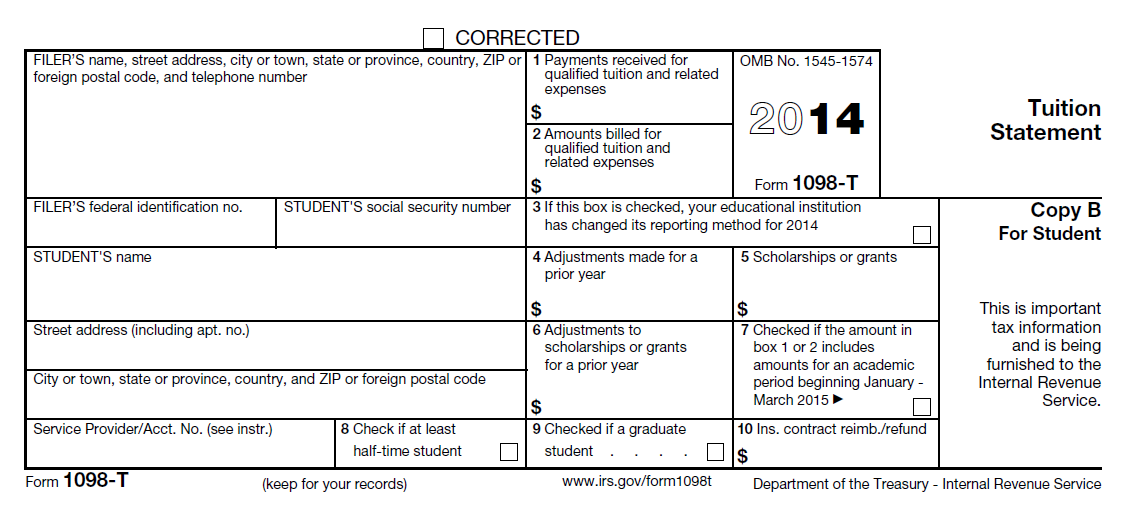
Blank Form 1098-T

I am not a tax attorney or tax consultant. This post was written while I was an undergraduate student at the University of Pennsylvania, and Co-Chair of the International Student Advisory Board.

IRS Form 1098-T, which educational institutions issue to students as a tuition statement for tax purposes, is used by many American families to claim educational credits or deductions on their federal tax returns.

Should international students have this form?

It’s complicated. In some situations, yes.

Universities often will choose not to issue this tuition statement to international students because those students can’t do anything with it. This is, however, an incorrect generalization.

Are international students able to use this form for anything?

Most international students are ineligible to claim those educational credits/deductions because they are nonresident aliens (e.g. F-1 student). These individuals would not benefit from having the 1098-T.

But some students, especially graduate students, may be eligible to claim credits/deductions because…

  1. they are resident aliens under the substantial presence test, usually because they have stayed in the United States for more than 5 years;
  2. they are nonresident aliens for immigration purposes, but resident aliens for tax purposes, maybe as spouses of American citizens or resident aliens; or
  3. they are nonresident aliens for both immigration and tax purposes, but eligible dependents of parents who are resident aliens/permanent residents/citizens; those parents are able to claim these credits in certain situations.

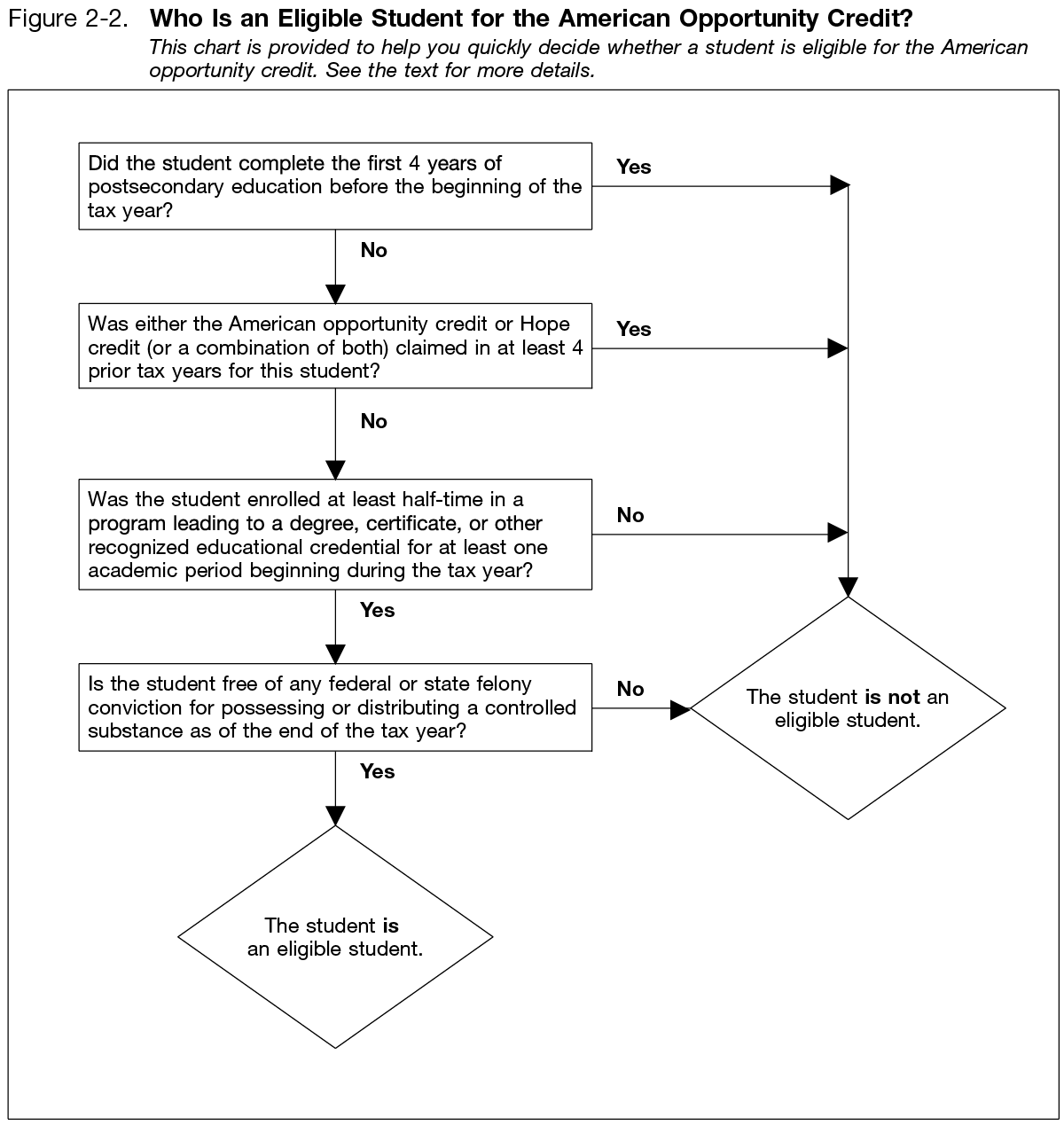
IRS Publication 970 explains who is eligible to claim the American Opportunity Credit. Of note: tax-free scholarships and grants affect whether, and how much, you can claim.

Figure 2-2 from IRS Publication 970, illustrating who is eligible to claim the American Opportunity Credit.
Figure 2-2 from IRS Publication 970, illustrating who is an eligible student for the American Opportunity Credit. Note: not all eligible students can claim. See Publication 970 for a flowchart of who is eligible to claim.

I am an international student in the above categories. Can I get a 1098-T from my school?

The IRS says that universities “do not have to file Form 1098-T or furnish a statement for… nonresident alien students, unless requested by the student“. Additionally, they are not required to provide it for “students whose qualified tuition and related expenses are entirely waived or paid entirely with scholarships”.

You must still meet all of the other requirements to get a 1098-T:

  1. Attend an eligible educational institution (college, university, vocational school, or other postsecondary educational institution in §481 of the Higher Education Act)
  2. Have paid qualified tuition and related expenses in that tax year
    • i.e. tuition, fees, course materials required to be enrolled
    • does not include room, board, insurance, medical expenses including student health fees, transportation, and personal/living/family expenses
  3. Receive credit for the completion of course work leading to a postsecondary degree, certificate, or other recognized postsecondary educational credential
    • i.e. most undergraduate bachelors programs and graduate masters and PhDs qualify
    • continuing education is often not included
  4. Be enrolled in any academic period of that tax year (consult IRS instructions for exceptions)
  5. Have provided your SSN or ITIN to the educational institution either through student records or an additional Form W-9S

What are some potential hurdles?

I was in a situation this year where my university did not issue me a 1098-T, and responded to my request with a form letter:

Does every Penn student receive a 1098-T?
Penn does not provide a 1098-T to non-resident aliens, or any student whose qualified charges are fully funded by grant, scholarship or tuition waivers, or any student who was enrolled in non-credit courses during the academic year.

They additionally stated,

“Though you might have received a 1098t form in the past, going forward as a Canadian citizen you will not receive one.”

As I’ve explained above in this post, this determination was a mistake. It conflates citizenship & immigration status with residency for tax purposes, and ignores the possibility that someone else other than me may be eligible to claim the credit.

Furthermore, even if I were a nonresident alien ineligible to claim the credit, nothing in the IRS regulations for Form 1098-T gives the educational institution the right, responsibility, or power to determine whether I might be eligible to claim the credit; nor does it permit them to deny a Form 1098-T to a nonresident alien’s request.

What does this situation reveal about international students?

First, on the superficial level, this situation reveals that immigration status and residency for immigration purposes differs from tax status and residency for tax purposes. Clearly, not all employees who handle these cases are aware of these stipulations.

More importantly…

International students are a large, diverse, and varied community. International students have complex needs based on their individual families’ statuses. It is a mistake to define broad, indiscriminate policies that treat all international students identically.

If you think I’ve made a mistake in this post, or wish to disagree with my conclusion here, I’d like to hear from you. Comment below or send me an email using the contact form.

Penn Engineering survey questions

Excerpts from the Penn Engineering student survey…

SEAS survey: “I can cope with being the only person of my race/ethnicity in a class”
Me: “Not applicable”

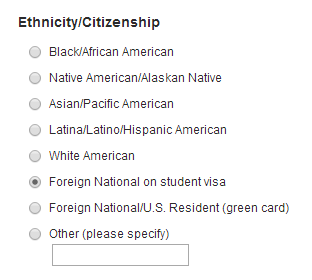
SEAS survey: select your ethnicity/citizenship…
Ethnicity or Citizenship question on survey

Me: why are these mutually exclusive?!

Installing Fedora 20 as a paravirtualized guest in XenServer with kickstart

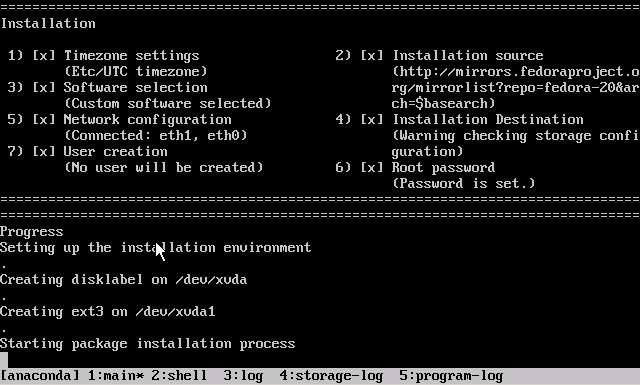
Anaconda beginning installation of Fedora 20 in XenServer

Updated 2014-07-13 with corrected links to develop-branch version and GitHub’s new user content domain name.

Updated 2014-07-17: see this newer blog post for instructions, kickstart scripts, and prebuilt images for CentOS 7 and Ubuntu 14.04.

Backstory

Earlier this year, I installed Xen Cloud Platform (XCP) 1.6 on an off-lease Dell CS24-TY with two quad-core Intel Xeon CPUs and 72 GB of RAM. (Those machines are sold by Dell Financial Services and on eBay for unbelievably low prices, for previous generation servers of such capability.) When Citrix open-sourced XenServer, I decided to upgrade XCP 1.6 to the full-featured XenServer 6.2.0 SP1, which added a few formerly-proprietary features for larger pools (which I do not have) and improved guest support for various OSes including Windows 8/Server 2012 among other changes.

At the same time, I started looking at switching domUs from Ubuntu—which worked great, by the way—to Fedora. This was purely due to personal preference, given my penchant for keeping software up-to-date even at the risk of instability, not any failings of Ubuntu.

The issue, of course, is that Fedora isn’t supported out of the box by XenServer or its management console XenCenter, and the wealth of knowledge out there typically pertains to older versions of Fedora and XenServer. Some IT firm even posted a tip to use the “Other install media” option for installing Fedora 20, which practically defeats the point of using Xen virtualization, since that creates a fully-virtualized guest (HVM) rather than a paravirtualized domU.

So I set out to update the existing methods of installing older versions of Fedora as a paravirtualized guest to the new release, Fedora 20 “Heisenbug”.

Credit where credit is due

I’m a sucker for giving credit to everyone and anyone, but in this case a few sources really formed the basis for what I’ve done:

Needless to say, both of these sources are super helpful, although none of them really work out of the box for what I’m doing.

The modified kickstart file

If you’re already experienced and you’re just looking for the kickstart, here it is. For installation instructions, see below.

I’ve created a GitHub repository for these, and I might add files for RHEL/CentOS 6.5 in the future, too.

Here’s the master-branch version: (if you’re adventurous, try the develop-branch version)

[github file=”/frederickding/xenserver-kickstart/blob/master/fedora-20/f20-server.ks”]

The master-branch files are typically tested, while the develop-branch files may introduce new features that are not yet fully vetted. (As the MIT License describes, everything is provided with no guarantees.)

The basic idea behind the post-installation script here is to create a legacy GRUB menu.lst file, which pygrub on XenServer can interpret to boot into a paravirtualized guest.

Update: now, the post-installation script doesn’t bother with a fake menu.lst at all, and instead makes GRUB2 configuration files. Based on reports that making slight alterations to the autogenerated GRUB2 grub.cfg file to make it compatible works, and based on the changes made to pygrub in upstream Xen (which have not yet been integrated into XenServer 6.2.0 SP1), I made the script tweak GRUB2 files and regenerate a grub.cfg with grub2-mkconfig. This should be robust enough to support future kernel updates!

How to use this kickstart (with screenshots!)

This procedure assumes that you’re familiar with XenCenter and have it running already. Continue reading “Installing Fedora 20 as a paravirtualized guest in XenServer with kickstart”

Spambots gone wild

On one of my sites running WordPress, Akismet (and other antispam plugins) is not installed. In some ways, it has served as a honeypot, revealing interesting tidbits about how spambots work.

Fascinatingly, there were several hundred of these comments, all identical to each other. They look like templates for comments to be generated by spam-producing software, except that the software never processed the templates and posted them verbatim instead: